Table of Contents
Complete Guide to Baby Ear Piercing – Pediatrician Tips & Safety.
Baby ear piercing can feel like a big decision. For many families, it’s more than just “cute earrings.” It can be:
- A cultural or religious tradition
- A way to celebrate a special moment
- A bonding experience between parent and child
At the same time, you want safety first. You may be asking:
Need a safer place to get your child’s ears pierced? See our medical ear piercing page in Roswell for booking, Blomdahl system details, and aftercare guidance.
- What is the best age for baby ear piercing?
- Is medical ear piercing really safer than getting it done at the mall?
- How do I keep my baby’s ears from getting infected?
This complete guide to baby ear piercing brings together pediatrician tips and safety advice from Omega Pediatrics in Roswell, Georgia, so you can make a calm, confident choice about baby ear piercing, infant ear piercing, and ear piercing for kids.
You’ll learn:
- The safest age ranges to consider for ear piercing
- The difference between medical ear piercing and mall or jewelry-store piercing
- Exactly what to expect during the procedure
- Simple aftercare steps to prevent infection
- Warning signs that mean it’s time to call your pediatrician
- Why a pediatric office like Omega Pediatrics is often the best setting
Important: This guide is for general education only and does not replace medical advice. Always talk with your child’s pediatrician about your baby’s specific health needs.
In this guide, you’ll learn 19 pediatrician-approved tips for safe baby ear piercing, from choosing the right age to spotting infection early
Section 1: Best Age for Baby Ear Piercing (Infants, Toddlers, and Older Kids)
One of the biggest questions parents ask is: “When is the best age to pierce my child’s ears?”
The honest answer: there is no one perfect age for every child. But there are safer ranges and smart guidelines you can follow for baby ear piercing and ear piercing for kids.
Pediatrician-guided timing: vaccines and safety
Omega Pediatrics recommends waiting until your baby is at least 3 months old and has received early vaccines before ear piercing. Very young babies have immature immune systems, so infections can be more serious. Vaccines help reduce the risk of certain complications.
By 3 months, babies are usually a bit stronger and easier to position and comfort. Some families choose to wait even longer, until their child can:
- Help a little with cleaning
- Say if something hurts
- Understand what is about to happen
Omega Pediatrics also notes that ages 2 to 10 can be a sweet spot for many children because:
- Earlobes are softer but not too delicate
- Kids are more likely to tell you if something feels wrong
- Risk of certain scars (like keloids—thick, raised scars) may be lower in younger children compared with teens and adults
Keloids are a kind of firm, raised scar that can grow larger than the original piercing hole. They are more common in some skin types and families.
Pros and cons by age group
To make this easier, let’s look at each age range.
Newborns (0–3 months): usually not recommended
For most pediatricians, this is too early for ear piercing because:
- The immune system is still developing
- Fevers and infections in young infants can be emergencies
- Babies this young cannot help at all with cleaning or comfort
If you are thinking about piercing a very young infant’s ears, it’s especially important to talk directly with your pediatrician first.
Young infants (3–12 months): possible with medical guidance
Between 3 and 12 months, infant ear piercing may be done safely when:
- Your baby is healthy
- Vaccinations are up to date
- The piercing is done in a sterile medical setting
- Parents can commit to careful aftercare
This is where medical ear piercing at a pediatric office can really help. The environment is cleaner, the equipment is designed for medical use, and the doctor can quickly address any problem.
Toddlers and preschoolers (1–4 years): more aware, still need help
In this stage, kids are:
- More active
- More expressive
- Sometimes more anxious
Pros:
- They can say “this hurts” or “this is itchy.”
- They can help hold still with your support.
Cons:
- They may tug at their ears or play with the earrings.
- They might resist cleaning if they are in a “no!” phase.
A calm, child-friendly pediatric office can make a big difference in how smoothly this age group handles ear piercing for kids.
School-age kids (5–10 years): often the easiest time
Many pediatricians feel school-age children are often the easiest and safest to pierce because:
- They can understand simple explanations.
- They’re able to sit still for a short time.
- They can help remind you if something feels sore or wrong.
- They can take some responsibility for their own aftercare (with supervision).
Tweens and teens
By this age, kids often have their own strong opinions about style and jewelry. They may want multiple piercings or cartilage piercings, which carry higher risks than simple earlobe piercings.
For this guide, we’ll stay focused on ear piercing for kids’ earlobes, especially babies and younger children.
Questions to ask your pediatrician about timing
Before you pick a date, take this list to your child’s visit:
- Does my baby have any health conditions that increase infection risk?
- Are vaccines up to date, including tetanus?
- Is my child at higher risk for keloid scarring or allergies?
- Is there any reason we should wait longer?
- Is medical ear piercing available in your office?
Your pediatrician knows your child’s health history and can help you choose the safest time for baby ear piercing or infant ear piercing.
Section 2: Medical Ear Piercing vs. Mall Piercing for Kids
You’ve decided you want your child’s ears pierced. Now the next big question:
“Should we go to the mall or to a doctor’s office?”
Let’s compare medical ear piercing with mall or jewelry-store piercing so you can see the difference clearly.
What is medical ear piercing?
Medical ear piercing is ear piercing done in a healthcare setting, usually by:
- A pediatrician
- A nurse
- A trained medical assistant
At Omega Pediatrics, medical ear piercing:
- Happens in a clean, clinical room
- Uses a medical-grade system with single-use, sterile cartridges
- Provides hypoallergenic earrings designed for sensitive skin
- Includes numbing options and follow-up support for families
This is very different from a quick pierce at a busy store.
For families near Roswell, Alpharetta, or Milton, you can book a medical ear piercing appointment in Roswell, GA with our pediatric team and have the procedure done in a calm, child-friendly setting.
What is mall or jewelry-store piercing?
Mall kiosks, jewelry stores, and similar locations often:
- Use piercing guns, which may be harder to sterilize properly
- Have varying levels of training and oversight
- May focus more on jewelry sales than on medical safety
Piercing guns can sometimes:
- Tear the skin rather than gently make a small, clean hole
- Be harder to clean between customers
- Increase the risk of infection or tissue damage if used incorrectly
What do pediatric experts say?
Pediatric professionals note that the safest choice is a clean, sterile, reputable facility. Tools should be fully sterilized or single-use, and parents should get clear aftercare instructions before leaving.
Because many piercing studios and kiosks are not strictly regulated, some pediatricians choose to offer safe pediatric medical ear piercing services in their own offices so families can feel more secure about hygiene and infection control.
Side-by-side comparison: medical vs. mall piercing
| Feature | Medical Ear Piercing (Pediatric Office) | Mall / Jewelry Store Piercing |
|---|---|---|
| Who pierces the ears? | Doctor, nurse, or trained medical staff | Store clerk or piercer (training varies) |
| Setting | Sterile, medical environment | Retail mall or shop |
| Equipment | Single-use sterile system or medical-grade needle | Reusable or semi-reusable piercing gun |
| Sterilization | Medical-level cleaning and infection control | Varies; guns can be hard to fully sterilize |
| Jewelry | Hypoallergenic, medical-grade materials | Quality varies; may contain nickel |
| Pain control | Numbing options often available | Numbing rarely provided |
| Follow-up care | Clear instructions; easy access to a pediatrician | Depends on store; limited medical follow-up |
When it comes to medical ear piercing for kids, the goal is not just “pretty earrings.” The goal is safe, clean, and low-stress care for your child.
Why Omega Pediatrics favors medical ear piercing
Omega Pediatrics offers professional infant ear piercing in a sterile clinic because children deserve:
- A safer, more controlled environment
- Direct access to a pediatrician if something doesn’t look right
- Medical-grade, hypoallergenic earrings that lower the risk of allergic reactions and infection
You can learn even more details about why children’s ear piercing is best done in a clinic in this article: 8 Reasons Why Children’s Medical Ear Piercing Is Better.
Section 3: What to Expect During a Medical Baby Ear Piercing Procedure
Knowing what will happen step by step can help you—and your child—feel calmer and more prepared.
Here’s what a typical medical ear piercing for kids might look like at a pediatric office such as Omega Pediatrics.
Step 1: Check-in, questions, and consent
First, you’ll check in just like any regular visit. The staff will:
- Review your child’s medical history
- Make sure vaccines are up to date
- Ask about allergies, especially to metals like nickel or to medicines
You’ll also sign a consent form saying you understand the procedure and agree.
Step 2: Choosing the right earrings
Next, you and your child (if old enough) pick earrings from a set of medical-grade, hypoallergenic options.
Common safe choices include:
- Medical-grade plastic
- Surgical stainless steel
- Titanium
- High-quality, nickel-free gold
Nickel is a common cause of jewelry allergies, so avoiding nickel-containing earrings is important, especially in children.
Step 3: Cleaning and marking the ears
The provider will:
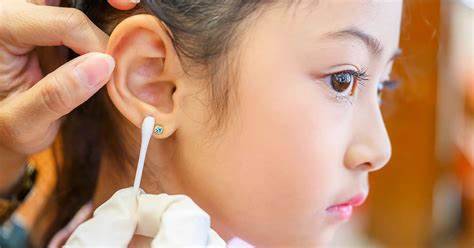
- Clean the earlobes carefully with an antiseptic solution.
- Use a marker to put a small dot on each ear where the earring will go.
- Show you the marks to check that both sides are even and centered.
This is a great moment to:
- Look closely at the markings
- Ask questions
- Adjust anything you’re unsure about before the actual piercing
Step 4: Numbing the area (if used)
Many pediatric offices, including Omega Pediatrics, offer numbing to make the process more comfortable for babies and kids.
This may be:
- A topical numbing cream applied to the earlobe
- Sometimes a small numbing injection, depending on the method and your child’s age
The cream usually needs a little time to work, so there may be a short waiting period.
Step 5: The piercing itself
Once the ears are clean, marked, and (if chosen) numbed:
- Your child will sit in a chair or on your lap.
- The provider will ask everyone to hold still for just a moment.
- Using a sterile, single-use system or a medical-grade needle, the provider makes a quick, precise piercing through the earlobe.
- The starter earring is placed immediately into the new hole.
Most kids feel:
- A quick pinch or sting
- Some warmth or mild throbbing afterward
The actual piercing takes only a few seconds per ear. The rest of the visit is for preparation and aftercare instructions.
Same-day and next-day appointments available.
Omega Pediatrics uses medical ear piercing for kids with hypoallergenic earrings and a sterile system designed for children’s sensitive skin. You can see more details and photos on their page for safe pediatric medical ear piercing services.
Step 6: Final cleaning and aftercare instructions
After both ears are pierced, the provider will:
- Clean around the piercings again
- Check that the earrings are snug but not too tight
- Review aftercare steps with you
- Tell you when to come back or when to call if something seems off
You may receive a printed aftercare sheet so you don’t have to remember everything.
Helping your child feel more comfortable
Here are simple ways to make the experience easier:
- Bring a favorite toy or blanket.
- For babies, plan the visit around nap or feeding time, so they’re not overly tired or hungry.
- For older kids, explain ahead of time what will happen using calm, honest words.
- Practice a deep breath together to use during the piercing.
A caring pediatric team will talk to your child in a gentle way, move quickly and confidently, and help them feel proud and brave when it’s all done.
Section 4: Aftercare and Infection Prevention for Baby Ear Piercing
Once your child’s ears are pierced, what you do at home plays a huge part in keeping them healthy and infection-free.
Think of aftercare as your daily ear care routine for the next few weeks.
How long does it take a pierced ear to heal?
For a simple earlobe piercing, healing usually takes about 6 weeks or a bit longer for most children.
During this time:
- The earrings should stay in
- The area should be cleaned regularly
- You should watch for any signs of trouble (we’ll cover those in Section 5)
Daily cleaning routine: simple checklist
Follow the instructions given by your pediatrician, but a typical routine may look like this (always ask your doctor which products to use):
- Wash your hands with soap and water.
- Gently clean the front and back of each earlobe with the solution your pediatrician recommends (this might be rubbing alcohol, saline, or another product).
- Carefully turn the earrings a small amount (if your doctor says this is okay) to prevent the posts from sticking to the skin.
- Pat dry with a clean tissue or cotton swab.
- Check for any redness, swelling, or discharge.
Do this once or twice a day as directed, usually for the first few weeks.
Rules to prevent infection
To reduce the chance of infection after baby ear piercing or infant ear piercing:
- Hands off. Remind older kids not to touch their earrings unless they are cleaning them. Try to keep babies’ hands away from their ears as much as possible.
- Avoid swimming pools, hot tubs, or lakes for at least the first couple of weeks, unless your pediatrician says otherwise.
- Keep hair products, lotions, and perfumes away from the piercing site.
- Make sure earrings are not too tight, which can trap moisture and bacteria.
- Do not switch earrings until the healing period is complete.
When can we change the earrings?
Most providers recommend keeping the starter earrings in place for at least 6 weeks, sometimes longer, to allow the skin to form a stable piercing channel.
Even after that:
- Always use clean, high-quality, hypoallergenic earrings.
- Change earrings over a soft surface, so you don’t drop one and risk contamination.
- Avoid heavy or dangling earrings for young children, as they can catch on clothes or toys and tear the earlobe.
Special considerations for babies and toddlers
For younger children:
- Check behind the ears daily; sometimes dried fluid can collect there.
- Make sure the backings are secure but not pressing into the skin.
- Keep long hair tied back so you can see the piercing area clearly.
- If your child is in daycare, tell caregivers about the new piercings and aftercare rules.
Creating a simple routine—like “clean ears after bath time”—can make aftercare feel manageable instead of stressful.
For a deeper dive into cleaning, healing, and more safety tips, you can also read Omega Pediatrics’ blog post Tips From a Pediatrician About Baby Ear Piercings.
Section 5: Signs of Ear Piercing Infection in Children and When to Call the Doctor
Even with great care, infections can still happen. The good news is that when caught early, most infections from baby ear piercing or ear piercing for kids can be treated quickly.
Omega Pediatrics highlights several common signs of ear piercing infection in children.
Common signs of ear piercing infection
Call your pediatrician if you notice:
- Redness and swelling that keeps getting worse
Some redness right after piercing is normal. But redness that spreads, along with increasing swelling, can signal infection. - Warmth and pain around the piercing
The ear may feel hot to the touch. Your child might cry, pull at the ear, or say it hurts. - Yellow or green discharge (pus)
A small amount of clear fluid early on can be normal. Thick, yellow, or green discharge—especially with a bad odor—is a concern. - Crusting that keeps coming back
Ongoing, heavy crusting may be a sign the site is not healing well. - Fever or your child seems very unwell
Fever after ear piercing may mean the body is fighting a more serious infection. - Earring stuck in the ear or embedded in the skin
Sometimes the backing presses in so much that it begins to sink into the skin. This is an urgent issue that needs medical care; do not try to dig it out at home.
For more pictures, examples, and practical tips, you can see Omega Pediatrics’ detailed article Signs of Ear Piercing Infection in Children.
When is it an emergency?
Call your pediatrician or seek urgent care right away if:
- Redness is quickly spreading beyond the earlobe
- Your child has a high fever or is very hard to wake
- You see red streaks running away from the ear
- Your child seems very sick (not eating, not drinking, very irritable, or unusually quiet)
If your child has trouble breathing, a swollen face or tongue, or signs of a severe allergic reaction, call emergency services immediately.
What NOT to do without talking to a doctor
If you suspect an infection:
- Don’t remove the earrings unless your pediatrician tells you to. Sometimes removing them too soon can trap infection inside.
- Don’t use random creams or home remedies on the piercing area. Some products can irritate the skin or make the infection worse.
- Don’t ignore it, hoping it will go away on its own—especially in infants.
Your child’s doctor may recommend specific cleaning steps or medicines. Follow their advice closely.
Section 6: Benefits of Professional Medical Ear Piercing for Babies and Kids
You’ve seen how medical ear piercing works and how to care for your child’s ears afterward. Now let’s look at the big-picture benefits of choosing a pediatric office like Omega Pediatrics instead of a mall kiosk.
1. Safer, more sterile environment
A pediatric office is built around infection control:
- Surfaces and tools are cleaned with medical-level standards.
- Sterile or single-use equipment is the norm.
- Staff are trained to prevent the spread of germs.
This can lower the risk of problems like bacterial infections.
2. Medical-grade equipment and jewelry
In medical ear piercing:
- Single-use cartridges or sterile needles are used—no sharing between clients.
- Earrings are designed for sensitive skin and are usually free of common allergens like nickel.
This helps reduce allergic reactions, irritation, and long-term skin problems.
3. A pediatrician who knows your child
When the piercing is done by your child’s own pediatrician, you gain:
- A provider who already knows your child’s health history
- Someone who understands any special risks (like immune problems or skin conditions)
- One trusted place to ask questions before and after the procedure
Choosing baby ear piercing by a pediatrician at Omega Pediatrics means your child’s ear piercing is part of their overall health care, not just a quick retail service.
4. Better pain control and emotional support
Medical ear piercing often includes numbing options to reduce pain.
Plus, pediatric teams are used to:
- Comforting anxious kids
- Explaining things in kid-friendly language
- Helping parents hold their child in a safe, supportive way
A calm, caring approach can turn what might be a scary experience into a confidence-building moment for your child.
5. Careful placement and long-term results
Pediatric professionals pay close attention to:
- The shape and size of your child’s earlobes
- How the ear will grow over time
- Cultural or personal preferences for placement
Good placement helps earrings:
- Look balanced on the face
- Avoid the edge of the lobe, reducing the chance of tearing
- Sit in a safe spot if more piercings are planned later
6. Clear aftercare and easy follow-up
With professional infant ear piercing in a sterile clinic, you get:
- Simple, written aftercare instructions
- Guidance that follows pediatric safety recommendations
- A clear plan for what to do if healing does not go as expected
If you have any worries, you can call a pediatric office, not a retail shop.
7. Respect for culture, family, and personal choice
Omega Pediatrics understands that ear piercing is a personal and often cultural decision. Some families pierce ears very early; others wait until a child can decide.
A good pediatric team will:
- Respect your family’s traditions
- Give you honest safety information
- Support you in making the best choice for your child
You can also explore more questions and answers in their extended FAQ article about pediatric ear piercing services: 20 FAQs About Pediatric Ear Piercing Services.
What You SHould Do Now: Book a Medical Ear Piercing Appointment in Roswell, GA
If you’re thinking about ear piercing for your baby or older child, this Complete Guide to Baby Ear Piercing – Pediatrician Tips & Safety is your starting point. Now you can take the next step and choose a safer option with medical ear piercing.
At Omega Pediatrics in Roswell, Georgia:
- Ear piercings are done by a pediatrician in a sterile setting.
- The practice uses a medical-grade system with hypoallergenic earrings designed for children.
- Numbing options and gentle, child-focused care are available.
- You do not have to be an existing patient to schedule an appointment.
👉 Ready to schedule?
Click here to book a medical ear piercing appointment in Roswell, GA.
You’ll find:
- Safe pediatric medical ear piercing services designed just for babies and kids
- Medical ear piercing for kids with hypoallergenic earrings that are gentle on sensitive skin
- Pediatric ear piercing done by a doctor, not a mall kiosk, in a clinic that already cares for children every day
Celebrate this special moment in your child’s life with confidence, comfort, and medical-level safety.
FAQs: Baby Ear Piercing, Safety, and Aftercare
Is baby ear piercing safe if it’s done by a pediatrician?
Yes. When baby ear piercing is done in a pediatric office with sterile tools and medical-grade earrings, it is much safer than having it done at a mall or kiosk. A pediatrician checks your baby’s health, reviews vaccines, and uses a clean, controlled process. This helps lower the risk of infection and other problems.
What is the best age to pierce my baby’s ears?
There is no single “perfect” age for infant ear piercing, but many pediatricians recommend waiting until your baby is at least 3 months old and has received early vaccines. Some families choose to wait until the child is older and can help with aftercare or say if something feels wrong. The safest choice is to talk with your pediatrician about your child’s health history and the timing that makes the most sense for your family.
Does medical ear piercing hurt my baby or child?
Your child will feel a quick pinch, but medical ear piercing is usually very fast. Many pediatric offices use numbing cream or other methods to make the ears more comfortable before the piercing. Afterward, the ears may feel a little sore or warm for a short time, like a small shot. Most children do very well when the piercing is done gently and explained in a calm, supportive way.
How long does it take baby ear piercing to heal, and when can we change the earrings?
For most children, an earlobe piercing takes about 6 weeks or a little longer to heal. During this time, you should leave the starter earrings in place, keep the area clean, and follow the aftercare steps your pediatrician gives you. Once healing is complete, you can switch to new earrings, but they should still be light, high-quality, and hypoallergenic to protect your child’s ears.
What kind of earrings are safest for babies and kids?
The safest ear piercing for kids uses hypoallergenic, medical-grade earrings. Good options can include medical-grade plastic, surgical stainless steel, titanium, or high-quality, nickel-free gold. These materials are less likely to cause allergic reactions or skin irritation. Heavy or dangling earrings are not a good idea for young children because they can catch on clothing or toys and pull on the earlobe.
What are the warning signs of an ear piercing infection, and when should I call the doctor?
Call your pediatrician if you see any of these signs around your child’s piercing:
Redness and swelling that gets worse instead of better
Yellow or green fluid (pus) coming from the hole
Ear feels hot, very painful, or your child keeps pulling at it
A backing that is stuck in the skin or seems to be sinking into the earlobe
Fever or your child seems very sick or unusually fussy
It is always better to call early and let a doctor check the piercing if you are worried. Quick treatment can keep a small problem from becoming a bigger one.
Want Blomdahl medical ear piercing in Roswell?
Visit the main booking page for sterile medical ear piercing, aftercare information, and scheduling.